House Valuation in Strijp-S
Property valuation Strijp-S guide with current asking-price and WOZ context, local housing types, liveability, schools, transport and mortgage checks.
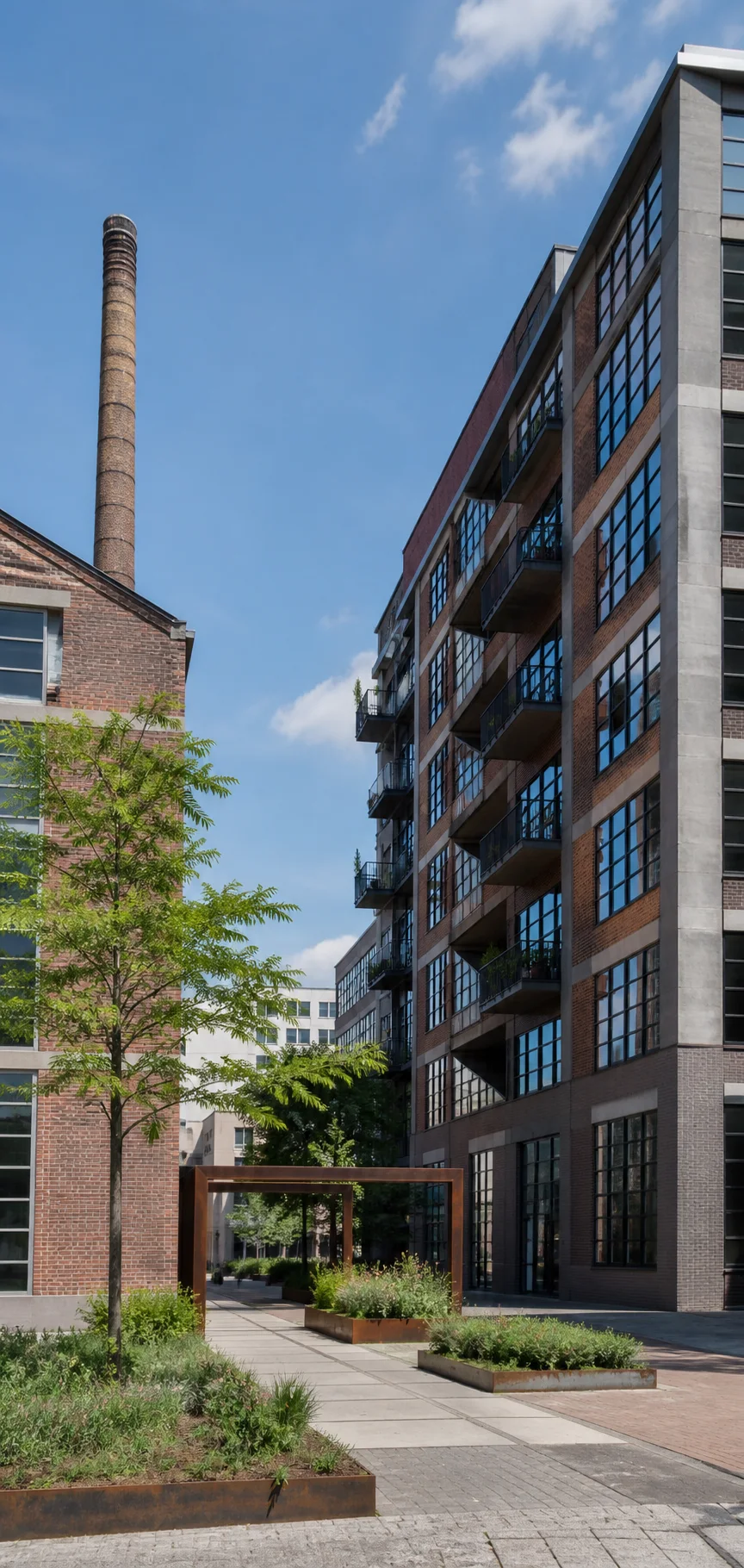
At a glance: Strijp-S is Eindhoven’s former Philips industrial district, now a dense mix of converted factories, new apartment buildings, design studios, cultural venues and public space. The 2025 CBS Strijp S neighbourhood row records 3,110 residents, 2,285 homes, an average WOZ value of €364,000, 100% multi-family homes and 10% owner-occupied homes. A Funda snapshot checked in August 2026 showed 6 homes for sale, an average asking price of €321,369, €5,304 per m² and 28 days’ average selling time, based on 50 homes sold in the previous 12 months. These are different measures and samples; neither sets the value of a particular apartment or loft.
Need a valuation in Strijp-S?
Speak directly with Dirk-Jan about your property, mortgage purpose and deadline. Request the report online.
Strijp-S in brief
At a glance: Strijp-S was a Philips industrial site from 1916 until its redevelopment as an open district for living, working, design, technology and culture. The official Strijp-S history describes the former factories, NatLab, Klokgebouw and the transition that began after the municipality and VolkerWessels acquired the site in 2002. The district now combines protected industrial buildings with contemporary apartment blocks, studios, hospitality, education and events. The Strijp-S vision makes the mixed-use, design-led character explicit.
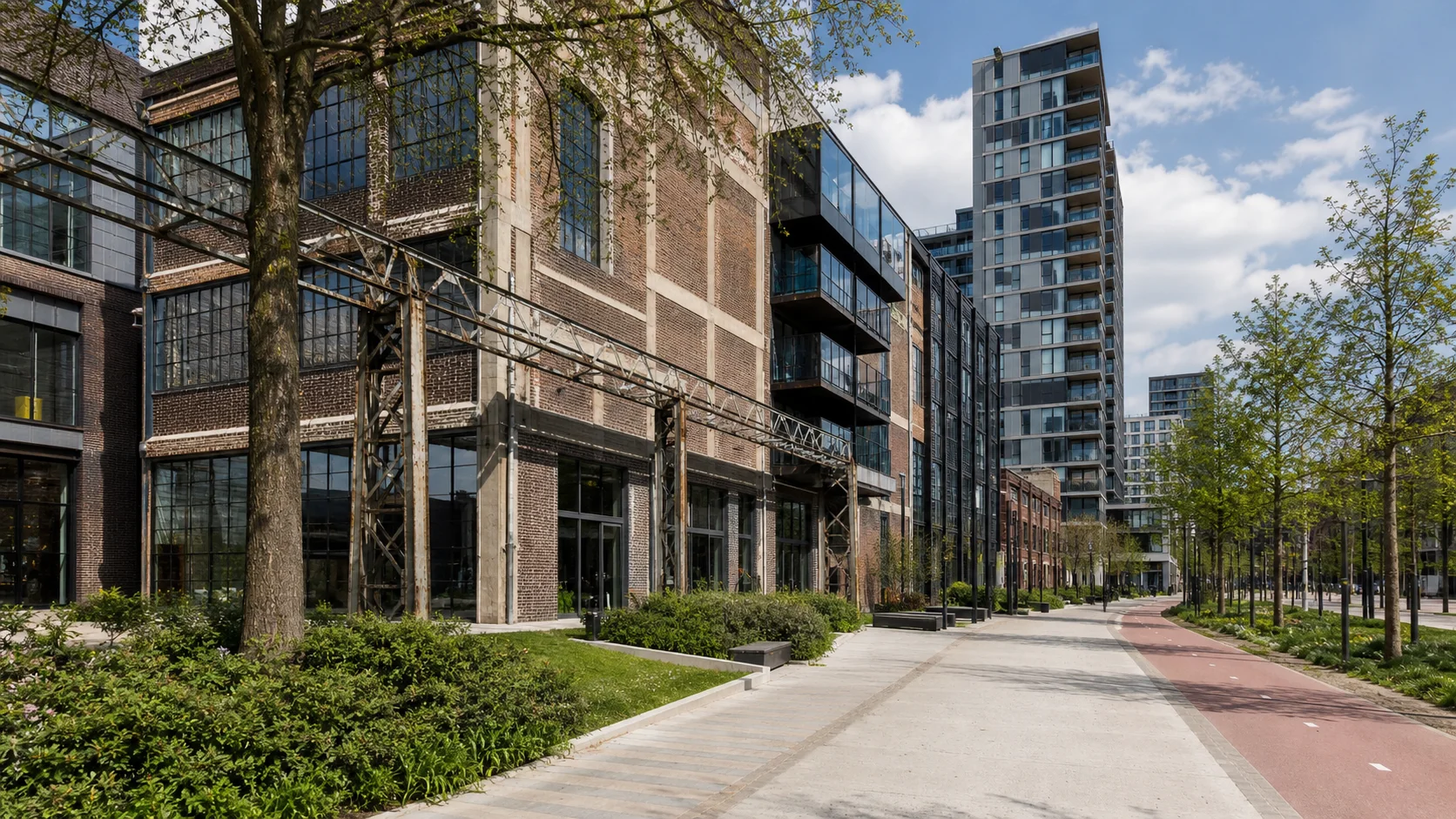
The neighbourhood is compact and apartment-led. CBS records 2,285 homes in 2025, all in the multi-family category, with 90% rented and 10% owner-occupied. The same row records 2,295 households, 69% one-person households and 4% households with children. A city-centre lifestyle, station access and cultural programme suit many professionals and international households; a buyer who needs a large garden, quiet streets or a conventional family-home supply should compare other Eindhoven areas as well.
Strijp-S is not one uniform building market. The Hoge Rug and Klokgebouw retain industrial fabric; Torenallee and Philitelaan include modern apartments and former factory conversions; the station edge has intense movement and changing development; NatLab, Area51, Urban Shopper, VEEM and FeelGood Market bring activity at different times. A valuation therefore starts with the exact building, floor, outlook, VvE and legal documents rather than with a district-wide average.
| Local profile | Strijp-S |
|---|---|
| Municipality / province | Eindhoven, Noord-Brabant |
| Official statistical geography | CBS buurt Strijp S (BU07726160), within wijk Oud-Strijp (WK077261) |
| Population / households | 3,110 residents and 2,295 households in 2025 |
| Typical housing stock | 100% multi-family homes; lofts, apartments and new-build blocks |
| Main buyer demand | Owner-occupiers, professionals, international households and buyers attracted to design-led urban living |
| Character | Former Philips industrial district with apartments, workspaces, culture, food, events and public space |
| Data coverage | CBS 2025 profile, Funda neighbourhood snapshot and public listing examples checked in August 2026 |
Your next step in Strijp-S
Local property market
Strijp-S at a glance
| Measure | Strijp-S (CBS) | Oud-Strijp (CBS) | Eindhoven municipality | Netherlands reference |
|---|---|---|---|---|
| Residents | 3,110 | 15,840 | 249,035 | 18,044,027 |
| Households | 2,295 | 10,080 | 130,304 | 8,430,352 |
| Homes | 2,285 | 9,354 | 121,191 | 8,274,478 |
| Average WOZ value, 2025 | €364,000 | €368,000 | €391,000 | €398,000 |
| Single-family homes | 0% | 32% | 58% | 63% |
| Multi-family homes | 100% | 68% | 42% | 37% |
| Owner-occupied homes | 10% | 30% | 44% | 57% |
| New homes recorded, 2025 | 369 | 848 | 1,529 | 69,189 |
| Population density | 10,419 per km² | 8,134 per km² | 2,829 per km² | 536 per km² |
| Average distance to GP | 1.1 km | 0.8 km | 0.8 km | 1.1 km |
| Average distance to large supermarket | 0.5 km | 0.6 km | 0.7 km | 1.0 km |
| Average distance to primary school | 1.1 km | 0.7 km | 0.7 km | 0.8 km |
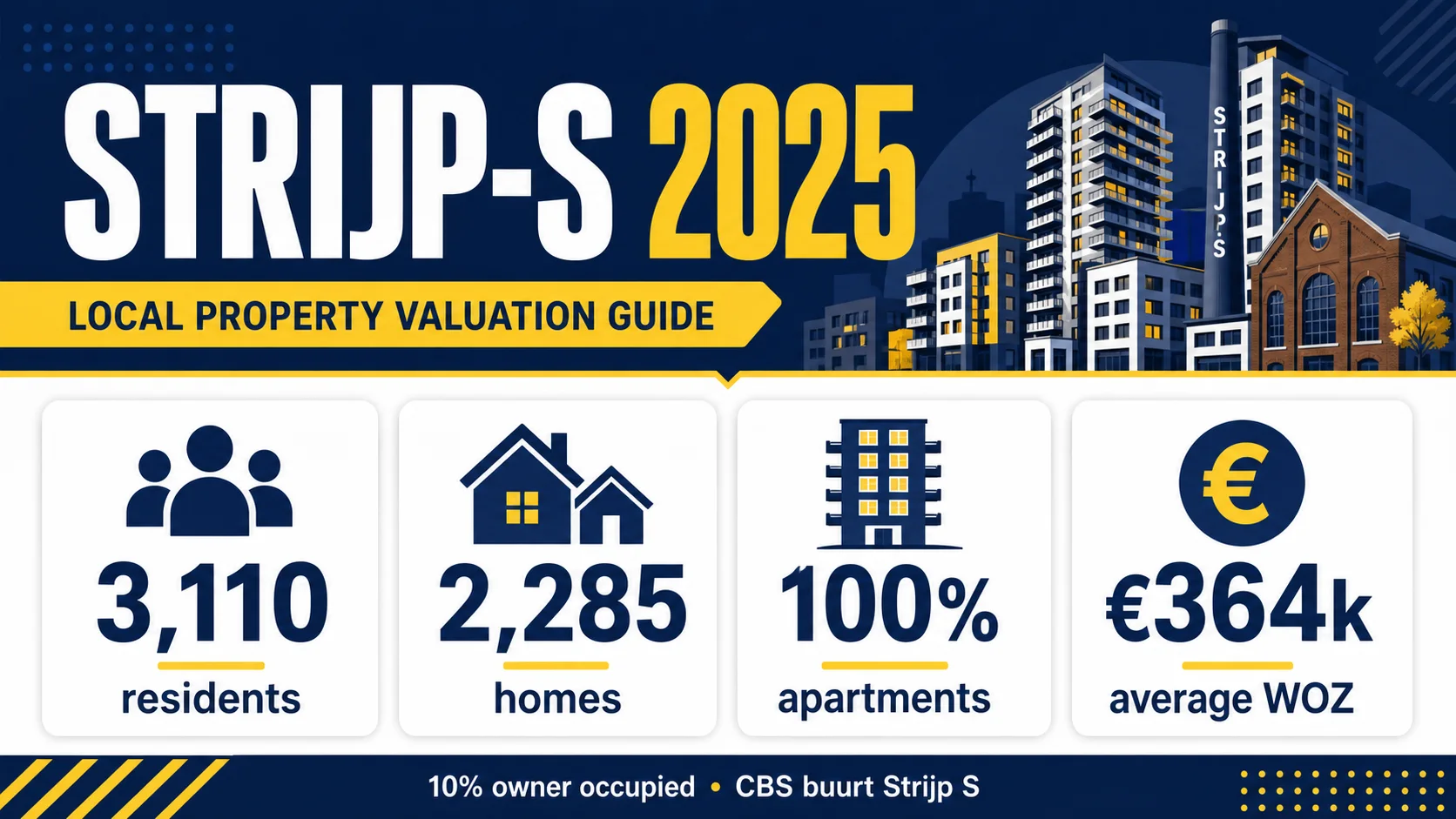
The figures come from CBS StatLine table 86165NED for Strijp S, with Oud-Strijp, municipality and Netherlands comparison rows from the same table. CBS WOZ is a tax-assessment measure, not a live asking price or a lender’s valuation answer. The very high apartment share and rental share explain why Strijp-S should not be compared directly with a suburban Eindhoven average.
Neighbourhood market snapshot
| Measure | Funda Strijp-S snapshot checked August 2026 | What it helps you check |
|---|---|---|
| Homes for sale | 6 | A small live sample; availability can change quickly |
| Homes for rent | 20 | Rental supply is much larger than the owner-occupied sale sample |
| Average asking price | €321,369 | Asking-price context only, not a completed-sale value |
| Average asking price per m² | €5,304 | Mix depends on size, floor, building, label and outdoor space |
| Average selling time | 28 days | Based on the Funda sample, not a promise for a particular home |
| Homes sold in previous 12 months | 50 | The sample boundary and method belong to Funda’s neighbourhood page |
| Residents shown by Funda | 3,105 | Close to, but not identical with, the CBS 2025 row |
The Funda Strijp-S neighbourhood page records these asking-price and selling-time indicators. Asking price, asking €/m² and selling time are not completed-sale evidence. The sample includes different building ages, floor levels, energy labels, VvE costs and parking arrangements, so it is useful for questions, not for copying a headline price into a purchase offer.
What the numbers mean
The €364,000 average WOZ is below the 2025 municipal and national comparison rows, while the Funda asking-price snapshot is expressed in a different way and reflects the current listing mix. A compact new-build apartment, an older converted loft and a larger penthouse can all sit within Strijp-S but have very different market evidence. The 100% multi-family figure describes the statistical housing category; it does not mean every building has the same layout, finish, service charge or legal structure.
The unusually high density and 0.5 cars per household also change what buyers should compare. Secure bicycle storage, lift access, balcony or roof terrace, parking status, daylight, event exposure, VvE finances and energy performance may matter more than a broad neighbourhood average. A lender-ready report uses suitable completed comparables and explains why each one is or is not relevant to the individual home.
Recent Strijp-S asking examples
| Example | Visible listing facts | Like-for-like question |
|---|---|---|
| Ir Kalffstraat 213 | €550,000 asking; 95 m²; energy label A; built 2012; 8 m² balcony; private parking; 21 m² storage; VvE €256 per month | Does the subject have the same floor, balcony, parking, storage, outlook and VvE structure? |
| Philitelaan 57-012 | €450,000 asking; 67 m²; energy label A+; built 2023; roughly 9–10 m² balcony; VvE €139.46 per month | How do new-build specification, floor, outdoor space, parking and service charge compare? |
| Torenallee 72-48 | €435,000 asking; 87 m²; energy label A; former Anton/Gerard factory loft; built 1927; VvE €379.53 per month; public parking | Are ceiling height, monument conversion, maintenance, VvE and public parking genuinely comparable? |
| Torenallee 69-080 | Funda search snapshot: €825,000 asking; 123 m²; energy label A+ | Does larger floor area reflect a different floor, terrace, view, finish or buyer pool? |
| Philitelaan 63-101 | Funda search snapshot: €389,500 asking; 66 m²; energy label A | Compare the building, floor, service charge, outdoor space and parking before using the €/m². |
These are public asking-price examples, not completed-sale valuations. A last asking price is not automatically the final transaction price. For a converted industrial property, the report must distinguish original building character from current condition, legal area, VvE obligations and the quality of the renovation.
Housing form, plot and condition
Strijp-S has no conventional detached-house market. Buyers compare studios, compact apartments, lofts, larger terraces and new-build blocks, often within buildings with shared entrances, lifts, bicycle rooms, parking arrangements and VvE governance. Former factories may have high ceilings, unusual layouts and monument or conversion constraints; a modern block may have better energy performance but higher service charges or a different reserve-fund profile.
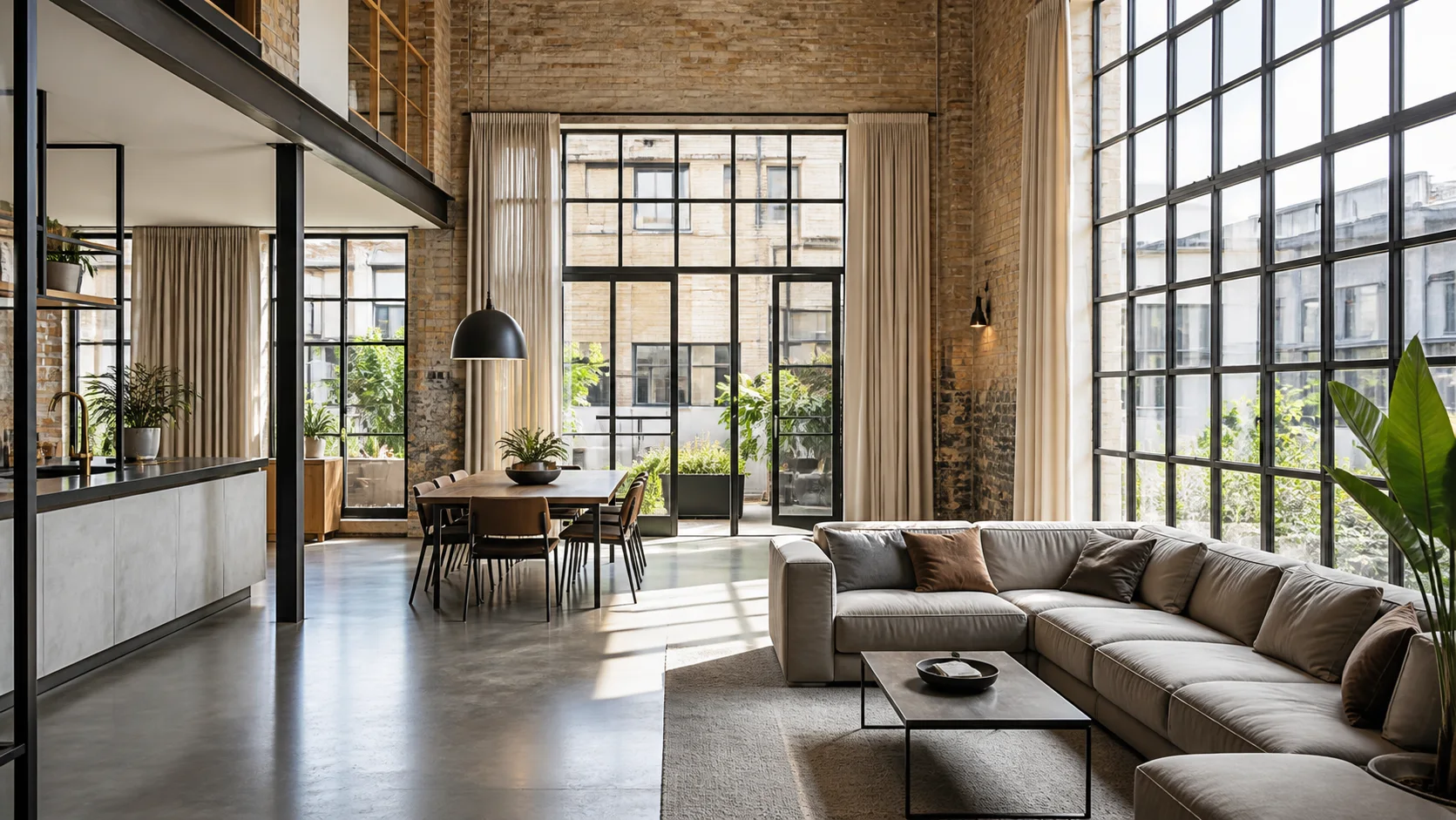
Before the inspection, gather the purchase agreement, floor plans, cadastral information, VvE documents, energy label, permits, renovation invoices and information about storage, bicycle space and parking. Confirm whether a balcony, roof terrace, parking place or storage unit is legally part of the property. The valuer must distinguish legal living area from common parts, storage and ancillary space.
Review VvE minutes, the MJOP, reserve fund, insurance, arrears, planned facade or lift works and any restrictions on letting, short-stay use or alterations. In a former factory conversion, ask for the renovation scope, warranties, maintenance records, monument obligations and any shared installation or foundation information. A representative image cannot establish these facts for a particular address.
Strijp-S setting and micro-location
The Strijp-S today overview shows how closely homes sit alongside design, shops, hospitality, education, culture and sports. The Klokgebouw is a national monument with event, studio and cultural functions; NatLab brings cinema, theatre, exhibitions and lectures; Area51, Urban Shopper, VEEM and FeelGood Market add different patterns of activity. A home beside an event venue, station edge or quiet courtyard should not be treated as equivalent to every other Strijp-S address.
| Practical setting | What to check before relying on a comparison |
|---|---|
| Hoge Rug and Klokgebouw | Monument status, event sound, shared entrances, facade condition and VvE maintenance |
| Torenallee and Philitelaan | Floor, outlook, balcony, lift, service charge, parking and construction nearby |
| Station Strijp-S edge | Rail and bus sound, bicycle movement, late activity, lighting and walking access |
| NatLab and event surroundings | Evening programme, deliveries, queues, window orientation and bedroom noise |
| Strijp-S4 development edge | Adopted plans, construction timing, daylight, access and future outlook |
| Glasgebouw and former factory conversions | Renovation quality, monument rules, legal area, installations and reserve fund |
Visit the address at more than one time of day. Check the bedroom side, balcony, entrance, bicycle storage, parking arrangement and public space during a normal weekday and an event or evening period when relevant. The Strijp-S accessibility page gives district-level context, but it cannot predict the experience of one building.
Market outlook
Strijp-S is still being completed. The official district site describes future development with additional homes and creative space, while the municipality’s housing-project dataset lists Strijp-S4 Veld B with 110 homes and Veld C with 300 homes in total, including 60 in the listed subarea, with indicative delivery years of 2030 and 2031. The municipality warns that the dataset is temporarily not current because of a technical upgrade, so these figures are planning context rather than a delivery promise.
The Glasgebouw renovation adds a planned 177 apartments to a protected former factory building, with residential, commercial and community functions. For a purchase or valuation, check whether a project is adopted, permitted, funded or still a concept. Construction can change noise, access, daylight and outlook before a completed improvement changes amenity.
What drives value in Strijp-S
Location premiums and discounts
Strijp-S premiums and discounts are often building-specific. A quiet, well-maintained loft with a good VvE, high ceilings, daylight, outdoor space and secure bicycle or parking provision may compare very differently from a similar-sized apartment beside an event entrance or active transport edge. Industrial character can support demand, but monument status, maintenance, conversion quality and service charges can also add cost.
| Value factor | Local signal to check | Why it matters | Questions for a buyer |
|---|---|---|---|
| Exact building and floor | Hoge Rug, Torenallee, Philitelaan, station edge or another block | A few hundred metres can change sound, light, outlook and buyer demand | Is the comparison in the same building type and micro-location? |
| Apartment and VvE | Reserve fund, MJOP, minutes, service charge, insurance and planned work | Future costs and restrictions affect value and financeability | Are roof, facade, lift and shared installations funded? |
| Living area and layout | NEN 2580 area, ceiling height, bedrooms, mezzanine, storage and balcony | €/m² depends on usable area and functional layout | Is the loft area legal and measured consistently? |
| Condition and energy | Glazing, insulation, ventilation, heating, label and renovation evidence | Running costs and comfort affect demand | Is the label current and is the renovation documented? |
| Light, outlook and noise | Rail, events, deliveries, bicycle movement, construction and courtyard exposure | Urban activity can be positive or negative at different times | What is the bedroom and balcony experience in the evening? |
| Parking and mobility | Owned space, garage, public parking, bicycle storage and shared mobility | Scarce parking and station access influence buyers | Is parking owned, permitted, leased or only public? |
| Tenure and legal restrictions | Freehold, monument status, conversion obligations, letting and use rules | Legal costs and consents affect marketability | What rights and restrictions are registered? |
| Planning and development | Strijp-S4, Glasgebouw and public-space decisions | Works can improve amenities or change light, access and sound | What is adopted and funded today? |
| Environmental exposure | Noise, air, heat, water and soil at the exact address | Comfort, cost and resale risk are address-specific | What do official maps and reports show? |
Property-specific valuation checklist
| Category | Checks |
|---|---|
| Legal title | Freehold or leasehold; registered restrictions; rights of way; monument or conversion obligations |
| Apartment / VvE | Reserve fund; MJOP; minutes; planned works; monthly fee; insurance; arrears; letting and alteration policy |
| Building quality | NEN 2580 area; construction and conversion year; roof; facade; windows; damp; asbestos; electrical system; heating |
| Energy and comfort | Official energy label; insulation; glazing; ventilation; heating; heat pump; district-heating contract; cooling |
| Shared spaces | Lift; entrance; corridors; bicycle room; storage; waste; access control; service contracts |
| Permissions | Internal changes, mezzanine, roof terrace, splits, rentals, short-stay use and listed-building approvals |
| Marketability | Natural light; layout; bedrooms; storage; balcony; noise; privacy; parking; lift; likely buyer pool |
| Costs | OZB, waste and water charges; VvE; maintenance; energy; insurance; parking; expected capital works |
Living in Strijp-S
Everyday character
Strijp-S offers a high-density urban lifestyle built around former Philips factories, apartments, design, workspaces, food and culture. The district has a strong identity and many everyday destinations, but it is not a quiet suburban estate. Events, deliveries, construction, bicycles, rail and evening activity can all be part of the environment. Buyers who value a balcony, storage, lift, quiet bedroom side and secure bicycle space should check those items at the exact building.
Expat suitability
Expat fit: High for professionals and international households who value design, English-friendly services and station access; mixed for families needing a garden, larger bedrooms or a guaranteed school place. Strijp-S’s creative and technology ecosystem, cultural venues and public transport can make arrival practical. Apartment documents, VvE rules and formal Dutch lender requirements still need careful explanation.
| Expat consideration | Local answer | Practical implication |
|---|---|---|
| International community | Strijp-S attracts technology, design, education and creative businesses | Central apartment supply can be competitive; building rules matter |
| English-friendly services | Official district information and many businesses serve international residents; Cheetah Valuations offers English intake | Confirm the formal Dutch report and lender wording early |
| International / bilingual education | Options exist in the wider Eindhoven area rather than in every Strijp-S block | Check admission, capacity and daily travel before buying |
| Childcare availability | Nearby providers exist, but capacity and waiting lists vary | Ask providers directly before relying on a location assumption |
| Rental-to-buy transition | The neighbourhood has significant rental stock and a smaller owner-occupied sale sample | Read VvE, lease and letting restrictions carefully |
| Employment access | Station Strijp-S, buses, cycling and the district’s own employers support car-light living | Peak travel and bicycle storage still need checking |
| Arrival practicality | Station, shared mobility, shops and services are close; parking rules vary | Check registration, parking and storage before signing |
Families and children
Family fit: Medium to mixed. Strijp-S has culture, sports, education and transport close by, but CBS records only 4% households with children and all housing is multi-family. Family-sized apartments exist, while private gardens, quiet play space and conventional family-home supply are limited.
| Family factor | Strijp-S | Buyer relevance |
|---|---|---|
| Primary schools | CBS places a primary school at an average 1.1 km; 12.9 schools are within 3 km on average | Catchment and capacity depend on the exact address |
| Secondary schools | City schools are reachable by bicycle or public transport | Compare daily travel, crossings and after-school arrangements |
| International schools | Wider Eindhoven options require a location-specific journey | Confirm admission and travel before choosing a home |
| Childcare and BSO | Nearby providers and De Ontdekfabriek add family activity, with capacity varying | Ask about waiting lists and opening times |
| Play and youth activity | Area51, De Ontdekfabriek and public spaces provide options | Check supervision, lighting, crossings and event use |
| Green access | Planted courtyards and public space are close, but private gardens are uncommon | Confirm the actual outdoor space and long-term outlook |
| Sports and culture | Area51, NatLab, SintLucas and district events add activity | Convenience can be high, but evening sound varies |
| Traffic and cycling | Dense cycle and pedestrian movement requires careful crossings and storage | Inspect the school-day and evening environment |
| Typical family home supply | Almost entirely apartments and lofts | Budget and building type narrow the buyer pool |
Safety and liveability
Safety context: Strijp-S has no single universal safety score that can be applied to every entrance. The police Mijn Buurt and Misdaad in Kaart tools let you check current incidents and burglary information at the relevant postcode or map area. Busy event, station and hospitality surroundings can produce more reports and movement than a quiet courtyard; that does not make every address unsafe.
For a Strijp-S home, check the entrance, intercom, bicycle storage, lighting, active frontages, crossings and the walk from the station or parking facility at the times you will use them. Reported incidents, perceived safety and the practical experience of returning home are different measures. Visit the exact block in daylight and after dark before committing to a purchase.
Liveability and environmental quality
| Factor | Local finding | How it can affect living quality and value |
|---|---|---|
| Urban density | 10,419 residents per km² in the CBS Strijp S row | Convenience is high, but privacy, parking and sound are building-specific |
| Air quality | Rail, road, construction and event activity vary by street | Check the exact address and ventilation strategy |
| Road and event noise | Rail, buses, deliveries, cycling, events and venues create different sound patterns | Visit at more than one time; windows and orientation matter |
| Heat and shade | Dense buildings and hard surfaces can change balcony and courtyard comfort | Check sun, shade, trees and future massing |
| Water and drainage | Urban surfaces and redevelopment require address-specific checks | Ground-floor, basement and drainage questions may matter |
| Soil and construction | Industrial history and redevelopment make official records useful | Review available environmental reports before relying on a view |
| Green-space access | Courtyards, planted streets and nearby district spaces provide relief | Access and outlook can support demand but are not guaranteed to remain unchanged |
Use Atlas Leefomgeving and municipal air-quality measurements for the exact address. These tools provide environmental context; they do not replace a property inspection or guarantee future conditions.
Getting around
Walkability and cycling
Walkability assessment: High for daily district services and culture. Strijp-S has shops, hospitality, workplaces, education, culture and Station Strijp-S close together. Event crowds, construction, bicycle movement and the quality of the final block still vary.
Cycling assessment: High, with building-level storage and junction checks. The district has wide lit cycling paths and links to Eindhoven’s network. Secure bicycle storage, crossings and the approach to the station matter more than a simple distance label.
| Everyday destination | Walk | Cycle | Public transport | Car | Reliability note |
|---|---|---|---|---|---|
| Station Strijp-S | 2–12 min | 1–6 min | 2–10 min | 3–15 min plus parking | Exact time depends on the building and station edge |
| NatLab / Klokgebouw | 3–12 min | 2–6 min | 3–12 min | 4–15 min plus parking | Event schedules can change the evening environment |
| Large supermarket | 5–15 min | 3–8 min | 5–15 min | 5–15 min | CBS average distance to a large supermarket is 0.5 km |
| GP / pharmacy | 8–20 min | 4–10 min | 6–18 min | 6–18 min | CBS average distance to a GP is 1.1 km |
| Primary school | 10–25 min | 5–12 min | 8–20 min | 8–25 min | CBS average distance to a school is 1.1 km |
| Eindhoven Centre | 15–30 min | 8–15 min | 10–20 min | 10–30 min plus parking | Congestion and works affect peak travel |
The Strijp-S accessibility page records five parking lots and garages with 1,408 spaces, available 24/7, plus HOV stops at Philitelaan and Hoge Rug, cycling paths and shared bikes and cars. The municipality identifies a shared-mobility hub on the west side of Station Strijp-S. Parking rules and prices can change, so check the current Mobility-S and municipal information before relying on a car plan.
Employment and regional access
| Destination | Why it matters locally | Cycle | Public transport | Drive (off-peak / peak) | Notes |
|---|---|---|---|---|---|
| Eindhoven Centre | City employers, shopping, services and station connections | 8–15 min | 10–20 min | 10–30 min | Central congestion and parking matter |
| Eindhoven railway station | Intercity and regional connections | 10–20 min | 8–15 min | 10–25 min | Check the live NS planner for departures and disruptions |
| High Tech Campus Eindhoven | Major technology and research employment area | 25–40 min | 25–50 min | 15–30 / 25–50 min | Peak congestion and transfers vary |
| Eindhoven Airport | International travel and airport employment | 25–40 min | 25–50 min | 15–25 / 25–45 min | Airport bus and peak traffic need checking |
| TU/e and city north | University, research and station-side employment | 15–25 min | 15–25 min | 15–30 min | New construction can change crossings and access |
Strijp-S makes many trips possible without a car, but not every household will find the same balance. Check secure bicycle storage, station access, peak congestion, shared-mobility availability and parking terms before choosing a building.
Amenities and leisure
The district’s amenity advantage is its concentration of culture, design, food, work and events. NatLab offers cinema, theatre, dance, exhibitions, lectures and a café. Klokgebouw hosts events and studios in a national monument. Area51 provides indoor skate and youth activity; Urban Shopper and VEEM add retail and design; SintLucas and De Ontdekfabriek add education and making; FeelGoodMarket runs on the third Sunday of each month with workshops, music and food. The same concentration means deliveries, evening activity, queues and event sound can be part of the daily environment.
Costs beyond the price
The valuation service fee is separate from the wider cost of buying or owning a Strijp-S home. Budget for mortgage advice, notary and transfer costs, inspections, insurance, VvE service charges, municipal taxes, water charges, maintenance, energy, parking and renovation. Ask the lender whether the report needs NWWI validation, a specific purpose, a particular deadline or an additional translation.
The standard residential valuation fee is €599 including VAT, with NWWI validation, cadastral research and travel within the normal service area included. A 24-hour report option can be requested for €60 extra when the property, access, documents and lender requirements allow it. Confirm any unusual building complexity, monument question, translation or rush handling before work starts.
Former factory apartments can add VvE, monument, shared-installation and maintenance costs. New-build blocks can add service charges, warranties, parking or shared-mobility arrangements. The €364,000 CBS WOZ average and Funda asking snapshot do not include these property-specific obligations.
Neighbourhoods within Strijp-S
| Practical area | Character | Valuation questions |
|---|---|---|
| Hoge Rug | Landmark former Philips buildings, lofts, workspaces and public space | Monument, conversion, lift, VvE, ceiling height and event exposure |
| Klokgebouw | National monument, events, studios and cultural activity | Sound, access, maintenance, shared entrances and reserve fund |
| Torenallee | Apartments, offices, hospitality and newer urban blocks | Floor, outlook, balcony, parking and construction context |
| Philitelaan | Apartment blocks, public space, HOV access and district activity | Transit sound, building specification, VvE and bicycle storage |
| Station Strijp-S edge | Rail, buses, bicycle flows and regional access | Evening activity, lighting, construction, sound and convenience |
| NatLab / Glasgebouw | Cultural venue and former factory conversions | Event programme, renovation quality, legal area and monument rules |
| Strijp-S4 edge | Planned additional housing and changing public space | Adopted plans, delivery status, daylight and future outlook |
These are practical place names, not additional CBS valuation boundaries. A listing can use “Strijp-S” while its building, VvE or project phase has a very different evidence set. Use the postcode, cadastral record and building documents to select comparable evidence.
Compare Strijp-S with nearby towns
Property valuation guide for Stratum
The Tuindorp, Stratum snapshot recorded an average asking price of €446,548 at €4,688 per m².
The Strijp-S snapshot recorded an average asking price of €321,369 at €5,304 per m².
Tuindorp, Stratum showed an average selling time of 23 days from 70 homes sold in the previous 12 months. Strijp-S showed an average selling time of 28 days from 50 homes sold in the previous 12 months.
In the 2025 CBS context, Tuindorp, Stratum records an average WOZ value of €439,000. In the 2025 CBS context, Strijp-S records an average WOZ value of €364,000, 10% owner-occupied homes.
Tuindorp, Stratum has the higher asking total, while its asking price per m² is lower than Strijp-S; larger homes or a different stock mix can account for that pattern. The Tuindorp, Stratum sample also moved about 5 days faster. Match the exact address, property type, plot, condition, energy performance and report purpose before using either headline as a comparable.
Property valuation guide for Gestel
The Blaarthem, Gestel snapshot recorded an average asking price of €388,095 at €4,698 per m².
The Strijp-S snapshot recorded an average asking price of €321,369 at €5,304 per m².
Blaarthem, Gestel showed an average selling time of 29 days from 34 homes sold in the previous 12 months. Strijp-S showed an average selling time of 28 days from 50 homes sold in the previous 12 months.
In the 2025 CBS context, Blaarthem, Gestel records an average WOZ value of €318,000 to €416,000. In the 2025 CBS context, Strijp-S records an average WOZ value of €364,000, 10% owner-occupied homes.
Blaarthem, Gestel has the higher asking total, while its asking price per m² is lower than Strijp-S; larger homes or a different stock mix can account for that pattern. The Blaarthem, Gestel sample moved about 1 day slower. Match the exact address, property type, plot, condition, energy performance and report purpose before using either headline as a comparable.
Property valuation guide for Tongelre
Funda snapshots for Tongelre neighbourhoods ranged from €304,714 to €817,548 in average asking price and €3,789 to €5,296 per m².
The Strijp-S snapshot recorded an average asking price of €321,369 at €5,304 per m².
Tongelre neighbourhoods showed an average selling time ranging from 22 to 30 days. Strijp-S showed an average selling time of 28 days from 50 homes sold in the previous 12 months.
In the 2025 CBS context, Tongelre neighbourhoods record an average WOZ value of €364,000 to €449,000. In the 2025 CBS context, Strijp-S records an average WOZ value of €364,000, 10% owner-occupied homes.
Strijp-S has a usable headline asking-price sample, while the Tongelre neighbourhoods figures are represented by a range or listing count. Match the exact address, property type, plot, condition, energy performance and report purpose before using either headline as a comparable.
To compare this area with nearby towns and neighbourhoods, visit the Eindhoven property valuation comparison hub.
FAQ
What does property valuation in Strijp-S mean?
It means an independent assessment of one apartment or loft in Strijp-S for a stated purpose, such as a mortgage, purchase, refinance or mortgage increase. The report considers the address, building, legal title, condition, area, VvE or monument documents, energy performance and relevant market evidence.
What is the average asking price in Strijp-S?
The Funda snapshot checked in August 2026 showed €321,369 average asking price and €5,304 per m², based on 6 homes for sale and 50 homes sold in the previous 12 months. It is a small asking-price sample, not a completed-sale median or a valuation of one apartment.
What is the average WOZ value in Strijp-S?
The 2025 CBS Strijp S row records an average WOZ value of €364,000. WOZ is a tax-assessment measure and should not be used as a mortgage valuation or purchase-price guarantee.
Are Strijp-S homes mostly apartments?
Yes. CBS records 100% multi-family homes in the Strijp S row. That includes different types of apartments, lofts, new-build blocks and former factory conversions with different layouts, VvE costs, floors, energy labels and buyer pools.
How should a former factory loft be valued?
The report should separate legal floor area, ceiling height, layout, daylight, conversion quality, monument obligations, installations, VvE finances and comparable completed evidence. Industrial character can support demand, but it does not remove maintenance or legal checks.
What should I check in a Strijp-S VvE?
Review the monthly fee, reserve fund, MJOP, minutes, insurance, arrears, planned facade or lift work, shared installations, bicycle storage, parking arrangements and rules on letting or alterations. Ask for the documents before relying on a listing description.
Does monument status affect a Strijp-S valuation?
It can. A protected building or former factory may involve consent, maintenance, facade, window, roof and alteration requirements. Gather the title, permits, reports, invoices and VvE information so the implications can be assessed for the individual home.
Is Strijp-S suitable for expats?
It can be practical for international households who value design, culture, station access and English-friendly intake. The trade-offs are a competitive apartment market, VvE documents, paid or building-specific parking and formal Dutch lender requirements.
Is Strijp-S suitable for families?
It is a mixed fit. Schools and activities are reachable, but CBS records only 4% households with children and all housing is multi-family. Check bedroom size, outdoor space, school capacity, crossings, event sound and storage rather than assuming a district-wide family profile.
How do events and rail noise affect a valuation?
They can affect comfort, buyer demand and which comparable homes are relevant. Visit the building at more than one time, check window orientation and ventilation, and review the exact relationship to venues, station activity, deliveries and construction.
How does parking work at Strijp-S?
The district accessibility page lists five parking lots and garages with 1,408 spaces, plus shared mobility and public transport. Rules, prices and availability are building- and date-dependent. Check whether a space is owned, leased, permitted or public before buying.
What are the Glasgebouw and Strijp-S4 plans?
The Glasgebouw renovation is described as a 177-apartment project in a protected former factory building. The municipal project dataset lists Strijp-S4 Veld B and Veld C housing with indicative delivery years, but the municipality says the dataset is temporarily not current. Check the latest adopted and permitted information for the exact address.
How quickly can I request a valuation?
You can submit the online request 24/7 or call +31 6 22660328 between 09:00 and 21:00, seven days a week. Cheetah Valuations normally responds within one hour during opening hours. A standard report is delivered within 48 hours after inspection when access, documents and agreed requirements are complete; a 24-hour option is available for €60 extra when confirmed at intake.
What does the standard €599 valuation fee include?
The standard residential fee is €599 including VAT, with NWWI validation, cadastral research and travel within the normal service area included. Confirm any unusual property complexity, monument question, additional translation, special lender requirement or rush option before work starts.
Does Cheetah Valuations offer English intake?
Yes. International buyers and homeowners can discuss the property, purpose, lender wording and documents in English. The formal report and lender requirements remain governed by the agreed Dutch process unless an additional translation is requested.
Who carries out the valuation?
Dirk-Jan Bonenkamp leads Cheetah Valuations. He is an NRVT-registered taxateur and NWWI appraiser who personally handles residential valuation intake, inspection and report preparation in Eindhoven and nearby towns.
What should I send before the inspection?
Send the property address, purpose, purchase agreement if available, lender or adviser wording, deadline, floor plans, cadastral and VvE documents, energy label, permits and renovation information. Early document review helps confirm the report form and prevents avoidable delays.
Relevant guides and next step
For the service overview, see property valuation services. For the formal request, use request a mortgage valuation. For Dirk-Jan’s background and registration, read about Cheetah Valuations. For practical document preparation, see documents needed for a mortgage valuation.